

DEVELOPING YOUR CLIMATE RESILIENCE PLAN
A climate resilience plan assists in testing the performance of an organization’s assets, operations, and supply chains in future climate conditions and helps in finding adaptation options that work in more than one scenario. This helps in applying resilience planning from theory to action to reduce risk associated with climate change.


WHAT IS CLIMATE RESILIENCE AND WHY DOES IT MATTER?
Climate risk and resilience planning is now a critical aspect of corporate sustainability and operational strategy. As global temperatures rise, extreme weather events, changing precipitation patterns, and regulatory changes are presenting new challenges to businesses. Organizations that proactively develop a climate resilience plan are better positioned to protect assets, maintain operations, and demonstrate leadership to investors, clients and regulators.
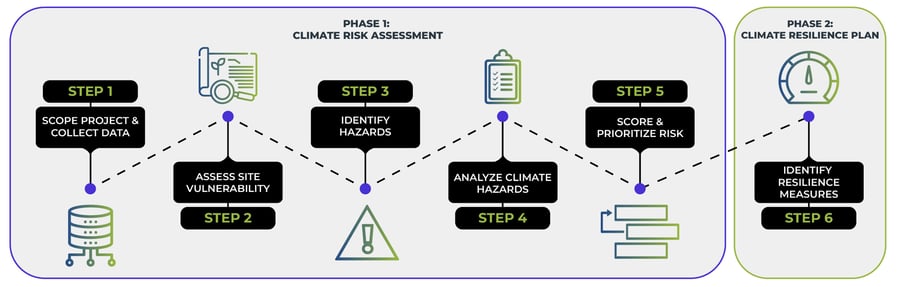
Tunley Environmental’s Climate Risk and Resilience Service provides a structured, two-phase process delivered by our PhD-level scientists, ensuring scientific precision and credibility. The first phase identifies and evaluates climate-related risks through a comprehensive climate risk assessment, while the second phase focuses on the development of a forward-looking climate resilience plan that translates insight into practical, costed actions. Together, these provide clients with both a clear understanding of their vulnerabilities and an actionable pathway to strengthen long-term preparedness and resilience.
A structured climate resilience plan helps organizations prioritize practical, high-impact mitigation actions based on their risks and vulnerabilities.
Outputs align with recognized frameworks such as TCFD, and CSRD, strengthening climate-related reporting and audit confidence.
A robust climate resilience roadmap demonstrates proactive planning and strengthens confidence among investors, regulators and wider stakeholders.
Tailored climate resilience solutions support operational continuity by reducing downtime, service disruption, and supply chain impacts during climate-related events.
By identifying vulnerabilities early, organizations can reduce recovery costs and financial exposure through informed resilience planning.
Specialist climate resilience consulting provides evidence-based insight into which adaptation and mitigation measures deliver the greatest resilience benefit, supporting smarter investment decisions.
COMPLETE PHASE 1: CLIMATE RISK ASSESSMENT TO UNLOCK YOUR CLIMATE RESILIENCE PLAN
If you have completed your Climate Risk Assessment externally or internally, we can still assist you in developing a Climate Resilience Plan. Get in touch and book your free consultation with our Sustainability Consultants.
HOW TUNLEY CAN HELP
A climate resilience plan helps organizations test how their assets, operations and supply chains will perform under future climate conditions and identify adaptation measures that remain effective across multiple scenarios. This enables resilience planning to move beyond theory and into practical, decision-ready action.
Tunley's climate resilience consulting services support organizations in developing a robust climate resilience roadmap grounded in scientific evidence. Our approach delivers practical climate resilience solutions aligned with business priorities, regulatory expectations and operational realities.

- What We Do
- How We Do It
- Assessment Impact
We develop climate resilience plans that translate your climate risk assessment into a tailored plan for your site or supply chain. We assess your organization’s exposure to climate-related risks and translate complex climate data into business-focused insights.
Our assessment provides:
- Physical Risk Analysis - Exposure to flooding, extreme heat, storms, drought, wildfire, and sea-level rise across assets and operations
- Transition Risk Analysis - Regulatory change, carbon pricing, investor pressure, market shifts, and supply chain disruption
- Reputational Risk Analysis – Risks specific to your business and its sector which could influence its reputation should something occur to the business
- Scenario Modelling - Risk evaluation under different global warming pathways (e.g. 1.5°C, 2°C, 4°C)
- Financial & Operational Impact Insight - Identification of revenue, asset, and cost implications
- Actionable Adaptation Planning - Clear, prioritized recommendations to strengthen resilience
You receive a structured assessment aligned to recognized frameworks such as TCFD and CSRD where relevant.
Step 6: Identify Resilience Measures
Development of a climate resilience plan is an iterative process. Once climate risks have been prioritized based on your organization's climate risk assessment, a resilience plan can be developed. This process requires conversations between Tunley Environmental and your team to ensure the best plan of action to ensure resilience across your site. Think of it as a research project, not based on specific steps, but utilizing identified risks to develop a tangible plan to ensure long-term climate resilience. This may include:
-
Information gathering, interview/questionnaires (filled out in the risk assessment if completed).
-
Preliminary suggestions of resilience measures, put together by our team. To be presented and discussed to ensure these suggestions are feasible and beneficial to your site.
-
Provision of a climate resilience plan with detailed benefits/impacts to increase resilience at your site to the specific climate risks identified.
This is delivered as Phase 2 because a Climate Resilience Plan must be built on a completed Climate Risk Assessment. A clear understanding of material risks is essential before effective adaptation strategies can be developed.
Where a robust climate risk assessment has already been undertaken, whether internally, by Tunley, or by a third party, we can build directly on that existing analysis to develop your resilience plan.
A Climate Resilience Plan delivers tangible value beyond compliance. It provides a pathway on how to integrate and increase the resilience of your organization to the greatest climate risks specific to your site.
Clear Visibility of Risk Exposure
You gain a structured understanding of where your organization is most exposed, across sites, assets, and supply chains, under multiple climate scenarios, and are provided solutions to imbed resilience into your organization.
Prioritized Action Plan
Rather than a list of theoretical risks, you receive a focused set of resilience measures, enabling confident resource allocation.
Stronger Governance & Board Oversight
The assessment supports enterprise risk management and provides verified evidence for board-level review and fiduciary responsibility.
Regulatory & Disclosure Readiness
Outputs align with recognized frameworks such as TCFD, and CSRD, strengthening climate-related reporting and audit confidence.
Operational Continuity
By identifying vulnerabilities early and planning for resilience, organizations can reduce downtime, protect critical infrastructure, and minimize disruption from extreme weather events.
Improved Investor Confidence
Demonstrating proactive climate risk management enhances credibility with financial stakeholders and supports long-term access to capital.
Long-Term Strategic Resilience
The assessment informs capital investment decisions, site selection, insurance negotiations, and supply chain planning, ensuring your organization remains stable and competitive in a changing climate.
We used Tunley Environmental to help us with out carbon reduction targets, they conducted an embedded carbon report for one of our key ranges and we are now exploring next steps. I would highly recommend them professional, helpful a great company to work with”
Kieron King
Quality Manager | Inpress
They did exactly what was asked and where we had less than perfect understanding of the issues involved their expertise showed through. The response time to follow up enquiries was excellent and I would happily use Tunley again.”
Michelle Smith
Intellectual Property Controller | Power Roll
The team were so helpful and made this project so easy and painless. The communication was well executed and the requests were clear. I would 100% recommend working with Tunley Environmental, for all your sustainability reporting.”
Louise Ewer
Operations Director | Wunder-Bar Dispensing
From start to finish the whole team have excelled in communication and support. They made the entire process seemless, and nothing was too much for them. This is my first full experience completing a carbon assessment, and I couldn't have asked for a better company to complete this with.”
Rebecca Druce
SQE Manager | Spacecare
We found all of the Tunley Environmental representatives to be extremely friendly, helpful and knowledgeable. They provided a high standard of service with plenty of advice and support, including regular meetings to update on progress and present findings. We look forward to working with Tunley Environmental again on future projects.”
Mary Bellamy
Lead Research Nurse | University Hospitals Birmingham NHS Foundation Trust
STANDARDS, FRAMEWORKS AND REGULATIONS WE ADHERE TO
Tunley’s methodology is developed and applied by our PhD-level scientists, integrating globally recognized frameworks to ensure scientific rigor, comparability and credibility.
- US SEC Climate-risk disclosures
- US SB 261 (California): Requires climate risk reporting for companies over 500 million USD turnover
- UN Sustainable Development Goals (SDGs): SDG 13 (Climate Action) and SDG 15 (Life on Land) guide alignment with global sustainability commitments.
- GRI Standards – Climate Risk (GRI 302, 305, 201 and 2021 update: GRI 101 Biodiversity): Findings and recommendations are mapped to GRI reporting indicators for transparent climate and biodiversity disclosures.
- BS EN ISO 14090:2019 - Adaptation to Climate Change: Principles, Requirements and Guidelines: Forms the backbone of Tunley's framework, ensuring consistent planning and monitoring of climate adaptation actions.
- BS EN ISO 14091:2021 – Adaptation to Climate Change: Guidelines on Vulnerability, Impacts and Risk Assessment: Underpins Tunley's risk identification and vulnerability analysis process.
- Taskforce on Climate-Related Financial Disclosures (TCFD): This framework is used to help organizations understand the climate risks to their business and provide confidence to stakeholders that they are seeking risk mitigation.
- Corporate Sustainability Reporting Directive (CSRD): Compliance with ESRS E1 (Climate Change) and ESRS E4 (Biodiversity and Ecosystems) disclosures.






COMPLETE PHASE 1: CLIMATE RISK ASSESSMENT TO UNLOCK YOUR CLIMATE RESILIENCE PLAN
If you have completed your Climate Risk Assessment externally or internally, we can still assist you in developing a Climate Resilience Plan. Get in touch and book your free consultation with our Sustainability Consultants.
WHY CHOOSE TUNLEY?
Delivered by PhD-level scientists, ensuring every climate resilience plan is justifiable, evidence-based and credible.
Clients receive a practical climate resilience plan, supported by a comprehensive climate risk assessment completed in phase 1, providing a complete picture of vulnerabilities and supporting informed, evidence-based decision-making.
Our assessments consider physical, transition and nature-related risks within a cohesive framework, with optional alignment to TNFD, SBTN and GBF.
Tailored by our expert consultants to your assets, operations and regulatory requirements, with experience across infrastructure, real estate, manufacturing, pharmaceuticals and public sector.
100% 5-star client feedback and awarded Best Sustainability Consultancy of the Year in 2024 and 2025.
OUR PhD SCIENCE TEAM
INSIGHTS OF INTEREST
The growing conversation around circular economy and carbon reduction is reshaping how industries approach sustainability, especially as businesses grapple with rising Scope 3 emissions and tightening regulatory expectations.
Read The Insight

Guidance for ESG managers on implementing DMA to align with CSRD and ESRS, using EFRAG's 6-step materiality process.
Read The Insight
The directive outlines specific requirements for what companies need to report, including the impact of their operations on the environment and society...
Read The Insight
Learn how to conduct a DMA to understand the interaction between a company's operation performance and the environment.
Read The Insight

Discover the latest updates on CSRD and how businesses can prepare for new reporting requirements starting in 2025.
Read The Insight

Learn how to prepare for CSRD with our comprehensive step-by-step guide, covering compliance requirements, timelines, and key strategies for success.
Read The Insight

To effectively navigate the full implementation of the CSRD, it is important to first understand what has changed in its scope, timeline and how to prepare your organisation for compliance.
Read The Insight

Discover the key differences between CSRD and NFRD, and how businesses can adapt to the new, more rigorous EU sustainability reporting standards.
Read The InsightFREQUENTLY ASKED QUESTIONS
A climate resilience plan is a forward-looking strategy that transforms the findings of a climate risk assessment into practical actions. It helps organizations strengthen preparedness, protect critical assets, minimize disruptions and build confidence with investors, regulators and stakeholders.
Our climate resilience consulting service deliver a tailored climate resilience plan built on scenario modelling and risk assessment. Clients receive targeted adaptation strategies, resilience pathways, scenario visualizations and prioritized actions to ensure operations remain robust under multiple future climate scenarios.
If you organization wants to move beyond understanding climate risks to taking practical action, a climate resilience plan is essential. It's particularly important for businesses with critical assets, supply chains or operations that could be disrupted by extreme weather, regulatory changes or other climate-related impacts.
Yes. A well-structured climate resilience plan demonstrates that your organization is proactively managing climate risks. It can support ESG reporting, regulatory compliance, insurance requirements and investor confidence by showing evidence-based adaptation strategies and long-term preparedness.
Using advanced scenario modelling, our team transforms risk insights into a climate resilience roadmap. This process evaluates physical, transitional and reputational risks, tests adaptation measures for robustness, and produces clear departmental actions, timeframes, KPIs and practical recommendations for resilient operations.
A climate resilience plan helps organizations prioritize actionable mitigation solutions, strengthen operational continuity, and improve stakeholder confidence. By providing insight into the most effective adaptation measures, our climate resilience consulting services deliver practical strategies that protect assets, minimize losses and support long-term sustainability.
Yes. Understanding the climate risks to your organization is essential to ensuring the resilience plan can be developed with the greatest risks in mind.
Yes. Tunley can interpret the results of your climate risk assessment work with you to develop a resilience plan based on your previous work.