

Science-based expertise

Have you had a hospital cannula? If not, it is a short plastic tubing that is put into a vein to quickly provide intravenous treatments. Most people consider it unpleasant but before 1945, it was substantially worse. Back then, UK hospitals used metal needles before plastic cannulas were invented, making any movement painful. Medical devices have advanced greatly in 80 years showing that innovation can continue. Still, we need more innovation, not only on the practical application of medical devices but in all aspects including sustainability. This leads us directly to Life Cycle Assessments (LCA’s). An LCA is an invaluable tool for identifying innovation and developing on improvements in all capacities. Conducting LCAs for medical devices can significantly contribute to sustainable MedTech innovation as it gives a detailed picture of the environmental effects and insights on how to mitigate them.
How LCAs Work for Medical Devices
Life Cycle Assessments (LCAs) are scientific methodologies used to quantify the environmental impacts of a product or process over its entire life cycle, from raw material extraction to end-of-life disposal. For the medical device sector, LCAs for medical devices provide essential data to understand and mitigate the carbon footprint, resource consumption and environmental trade-offs involved in product development. ISO 14040 and 14044 standards set up the basic method to conduct thorough LCAs in medical technology. ISO 14040 describes the principles and framework, while ISO 14044 details the technical requirements.
In addition to these international standards, there is growing interest in more sector-specific guidance. For example, PAS 2090 Life Cycle Assessment has been developed to support the assessment of environmental impacts for pharmaceutical products. This provides a more tailored framework for organisations operating within healthcare and life sciences, helping ensure that life cycle assessments reflect the unique requirements of medical and pharmaceutical supply chains.
LCAs are typically structured around four phases:
-
Goal and Scope Definition:
-
Inventory Analysis:
-
Impact Assessment:
-
Interpretation:
Amidst increasing regulatory scrutiny like the EU's Medical Device Regulation (MDR) and the NHS’s Net Zero Supplier Roadmap, conducting LCAs for medical devices is fast becoming an essential component of medical device procurement and compliance.
Steps to Integrating LCAs in Medical Device Development
Embedding life cycle assessment into every stage of a medical device development can lead to superior environmental outcomes. Here are the steps to take when integrating LCAs for medical devices in the development stages:
Step 1: Consider LCAs in Early Product Design
The earlier LCAs are integrated into the design process, the more value they can deliver. Early-stage design is where most of a product’s environmental impacts are locked in. LCAs for medical devices look at environmental aspects and their effects throughout a product's life: from raw materials to production, use, recycling and disposal. The design process becomes more sustainable when we build these considerations into its foundation rather than just evaluating them later. During the early design phase, it’s important to set clear goals and boundaries. The design team should define their expectations by stating:
- The assessment's purpose
- The product's exact definition and life cycle
- System boundaries that show what's included and excluded
These guidelines will help develop a solid framework to evaluate the device. The team must also identify their target audience because this shapes which insights matter most for assessing and interpreting impact. Medical devices need special attention to sterilisation needs, clinical usage pattern and specific disposal methods.
Key benefits of early LCA integration include:
- Avoiding costly redesigns: Environmental hotspots can be identified and mitigated before prototyping begins.
- Enhancing cross-functional collaboration: Early integration fosters alignment between sustainability teams, engineers and regulatory professionals.
- Designing with the end in mind: Considering disposal, disassembly and recycling from the outset supports circularity.
Step 2: Compare Materials Based on Product Carbon Assessment
A device's environmental impact depends heavily on material choice. Early LCA studies show raw material production creates the biggest environmental effect, along with waste management through incineration. The design team can slash the overall carbon footprint by comparing materials during early concept phases.
Materials affect sustainability in many ways including:
- Reuse or reprocessing options
- End-of-life recyclability
- Manufacturing energy needs
- Weight-related transport emissions
Early material assessment helps designers balance clinical needs with environmental care before finalising design choices.
Step 3: Use LCAs to Guide Prototyping and Iteration
Once the design process has progressed to prototype, LCAs become an important decision-making tool for incremental improvements. Environmental data gathered through life cycle assessments can be used to compare design alternatives and refine the product based on real-world impact projections.
Applications include:
- Material substitution: Testing alternative materials for carbon intensity, toxicity and recyclability.
- Functional redesign: Assessing the impact of simplifying a product or removing unnecessary components.
- Packaging trials: Exploring low impact packaging options and quantifying their benefits in relation to transport and disposal.
A Guide to Sustainable Pharmaceuticals
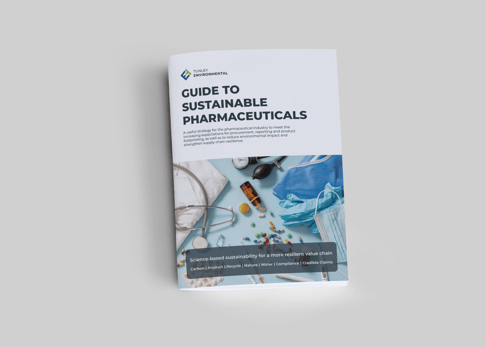
It will help you to:
- Identify material carbon, energy, water, waste, pollution, biodiversity and resource impacts
- Navigate compliance requirements and expectations
- Build an organisational carbon baseline and a credible, investable reduction plan
- Use pharmaceutical Life Cycle Assessment (LCA) and product carbon footprinting to understand impacts
- Improve Scope 3 data and supplier engagement
- Prioritise actions that support resilience, tender readiness, operational efficiency and defensible sustainability communication.
Benefits of LCAs for MedTech Innovation
Integrating LCAs into product design, procurement and supply chain strategies allows MedTech companies to accelerate innovation while supporting pharmaceutical sector sustainability goals.
Informed Material Selection:
LCAs reveal the environmental impact of raw materials, helping designers choose low-impact, recyclable or biodegradable materials.Design for Disassembly and Recyclability:
By examining end-of-life scenarios, LCAs guide the creation of devices that are easier to dismantle and recycle.Reduction of Energy Consumption:
LCAs help identify energy-intensive stages of manufacturing or usage, enabling targeted efficiency improvements.Benchmarking and Continuous Improvement:
By conducting LCAs across generations of products, companies can track and document environmental progress over time.Driving Circular Economy Models:
LCAs support the transition from linear to circular business models by highlighting opportunities for reuse, remanufacturing and recycling.
Learn more: 6 Benefits of a Life Cycle Assessment
Supporting Pharmaceutical Life Cycle Assessments with PAS 2090
As sustainability expectations increase across the healthcare sector, more specific frameworks are emerging to support consistent and robust assessments. PAS 2090 is one such framework, designed to guide the life cycle assessment of pharmaceutical products.
For organisations working across both medical devices and pharmaceuticals, this provides an opportunity to align methodologies and ensure consistency in how environmental impacts are measured and reported.
Applying PAS 2090 can help organisations strengthen compliance, improve transparency in supply chains, and better respond to growing procurement requirements from healthcare providers and regulators.
The Role of LCAs in Medical Device Procurement
Procurement decisions in the healthcare sector are increasingly influenced by sustainability considerations. LCAs for medical devices provide the evidence needed to support sustainable procurement decisions, offering a competitive edge in both public and private tenders. Advantages of incorporating LCAs into procurement strategies include:
Transparency:
Buyers gain a clear understanding of the environmental impact of competing products.Risk management:
LCAs uncover hidden environmental liabilities that may pose future regulatory or reputational risks.Lifecycle cost analysis:
Combining environmental data with cost analysis supports long-term value-driven purchasing.According to the UK Government’s Public Procurement Note 006 (PPN 006), organisations bidding for major government contracts must now consider the environmental impact of their products and services. LCA documentation strengthens such bids significantly. The NHS Evergreen Sustainable Supplier Assessment, for example, increasingly favours suppliers with robust LCA documentation.
Read More: PPN 006 Requirements for NHS | Tunley Environmental
The Bottom Line
Product carbon assessment helps create better medical devices that work for patients and protect our planet. Manufacturers use LCAs to spot areas they can improve, make smarter design choices and create eco-friendly medical devices that still deliver excellent clinical results.