

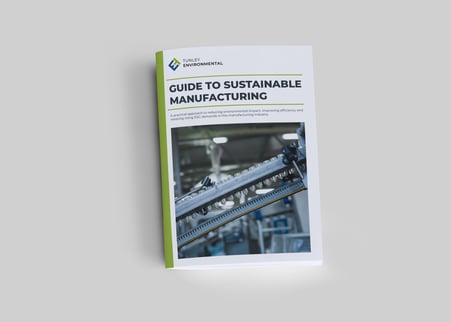
Sustainability has is one of the defining issues for the global manufacturing sector. As operational pressures rise, regulations tighten and customers demand credible environmental performance, manufacturers have more incentive to integrate more sustainability measures in their operations. To support manufacturers through this transition, we recently released a new guide to sustainability in manufacturing, offering a practical, science-based roadmap for reducing environmental impact, improving resource efficiency and strengthening compliance.
Why Sustainability in Manufacturing Matters
Manufacturing is responsible for a substantial share of global emissions and resource consumption. According to the World Resources Institute, manufacturing and construction account for 12.7% of global emissions, largely driven by energy-intensive processes, heat generation, logistics and material extraction. Energy use across the sector remains high, industrial processes generate waste at scale and supply chain emissions routinely make up 70–90% of an organisation’s total carbon footprint. Against this backdrop, the importance of sustainability in manufacturing has increased dramatically. Rising energy prices, tightening regulations, shifting customer expectations and accelerating climate impacts mean sustainability is becoming synonymous with operational efficiency, risk management, product competitiveness and market access.
Environmental Challenges Unique to Manufacturing
Unlike service-based sectors, manufacturing faces broad and interconnected sustainability issues. Many of these are outlined in the full guide to sustainability in manufacturing, which details the pressures created by energy-intensive processes, complex supply chains and material-heavy production cycles.
- High Energy Consumption
Industrial energy use accounts for roughly 37% of global final energy consumption. Manufacturing processes often rely on high-temperature operations, historically powered by fossil fuels. This leads to significant Scope 1 and Scope 2 emissions, cost volatility and regulatory exposure. - Material Inefficiency
Inefficiencies arise from offcuts, defective stock, packaging, rejected batches and poor material flows. For some manufacturers, poor material use is a costly loss of usable resources. - Pollution and Air Quality Impacts
Manufacturing processes may produce volatile organic compounds (VOCs), particulate matter, nitrogen oxides and other pollutants. When combined with transport emissions from inbound and outbound logistics, this creates local environmental impacts that attract regulatory scrutiny. - Scope 3 Emissions and Supply Chain Complexity
For many organisations, more than 70% of total emissions sit outside their direct control. This makes sustainability issues in manufacturing particularly challenging, as visibility across global supply chains is limited and supplier engagement requires structured approaches. - Balancing Targets with Tight Margins
Some manufacturers operate with narrow margins and limited capital for major upgrades. Transitioning to sustainable manufacturing therefore requires targeted, high-impact investments rather than broad, unfocused initiatives.
The Six Pillars of Sustainable Manufacturing
A core component of the guide to sustainability in manufacturing is its six-pillar framework, designed to help organisations adopt a simple, practical framework for embedding sustainability across operations.
Pillar 1 - Energy Efficiency and Renewable Integration: Manufacturers can reduce operational costs and emissions through energy audits, smart monitoring, electrification and renewable-energy integration.
Pillar 2 - Sustainable Materials and Low-Carbon Design: Assessing material impacts early in the design phase allows organisations to reduce carbon intensity and optimise performance.
Pillar 3 - Resource Optimisation: Lean manufacturing, packaging redesign and closed-loop processes can significantly improve resource efficiency.
Pillar 4 - Sustainable Supply Chain and Scope 3 Transparency: Structured supplier engagement, emissions data collection and sustainability-aligned procurement criteria strengthen both compliance and competitive positioning.
Learn More: Sustainable Procurement ISO 20400 | Tunley Environmental
Pillar 5 - Clean Technology and Innovation: Automation, digital optimisation, low-carbon heating technologies and process modernisation contribute to long-term decarbonisation and efficiency gains.
Pillar 6 - Verified Reporting and Compliance: Manufacturers must increasingly align with regulatory frameworks such as:
- EU Carbon Border Adjustment Mechanism (CBAM)
- Corporate Sustainability Reporting Directive (CSRD)
- European Sustainability Reporting Standards (ESRS)
- UK Green Claims Code (UKGCC)
Verified assessments such as Business Carbon Footprint Assessments (BCAs), Life Cycle Assessments (LCAs), Environmental Product Declarations (EPDs) and Embodied Carbon Assessments (ECAs) allow manufacturers to meet regulatory expectations and provide reliable sustainability data to stakeholders.
Product-Level Sustainability: LCA and ECA
One of the most valuable areas explored in the guide to sustainability in manufacturing is managing sustainability at the product level. LCA and ECA help manufacturers quantify impacts across the full product lifecycle or up to the factory gate, supporting improvements in product design and supply chain management.
LCA provides cradle-to-grave insights, revealing environmental hotspots, material impacts and opportunities for redesign. ECA focuses specifically on upstream emissions, helping manufacturers demonstrate lower-carbon alternatives to customers and comply with tender requirements. Case studies such as Power Roll and PB Design illustrate how lifecycle assessments strengthen market positioning, support innovation and build confidence among investors and customers.
Integrating Biodiversity and Supply Chain Sustainability
The guide highlights the rising expectations surrounding biodiversity, ecosystem impacts and responsible sourcing. Manufacturers are increasingly expected to support nature-positive outcomes and to demonstrate awareness of both carbon and biodiversity risks within supply chains. Tools such as Supply Chain Biodiversity Footprint (SCBF) assessments help identify nature-related impacts and align decision-making with emerging frameworks like the Taskforce on Nature-related Financial Disclosures (TNFD).
The Bottom Line
Manufacturers are operating in a landscape shaped by rising costs, tightening regulations and growing expectations for credible environmental performance. In these changing times, sustainability should be approached as a fundamental driver of resilience, efficiency and competitiveness. The new guide to sustainability in manufacturing demonstrates that progress is achievable when organisations take a structured, evidence-led approach that integrates energy efficiency, material optimisation, circularity, supply chain transparency and verified reporting into day-to-day decision-making.