


Understanding Why the PAS 2090 Life Cycle Assessment Framework Matters
For pharmaceutical companies, environmental life cycle reporting is rarely straightforward when compared to other sectors. This is because the sector operates within a highly regulated environment, where patient safety, product efficacy, quality assurance, data integrity and supply continuity all come first. Against that backdrop, any new framework or standard can understandably feel like another layer of compliance to interpret, resource and manage.
The PAS 2090 life cycle assessment framework may initially appear to pharmaceutical teams as another layer of complex regulatory expectations, supplier requirements and sustainability reporting obligations. Nevertheless, the framework has been developed to address a genuine challenge that the pharmaceutical industry is facing: the consistent, verified, and science-based measurement and communication of the environmental impact of pharmaceutical products.
The PAS 2090 life cycle assessment framework encourages pharmaceutical companies to examine the entire life cycle of their products, rather than the isolated stages of production alone. This can encompass the following: raw materials, active pharmaceutical constituent production, formulation, packaging, distribution, product use, and end-of-life considerations. The framework helps organisations understand where environmental impacts occur across the product journey and assess those impacts with greater consistency, rather than treating sustainability as a separate reporting exercise.
What Is The PAS 2090 Life Cycle Assessment Framework?
The PAS 2090 life cycle assessment framework was specifically designed for pharmaceutical products. It provides the product category criteria for conducting environmental life cycle assessments (LCAs), in a manner that is consistent with the unique complexity of pharmaceutical supply chains and medicines.
This is important because it is not always straightforward to evaluate pharmaceutical products using generic environmental methods. Their effects may be dispersed across multiple life cycle stages, from energy-intensive manufacturing and specialist ingredients, to cold chain logistics, protective packaging, delivery devices such as inhalers, patient use, and disposal. In the absence of a unified methodology, two organisations that evaluate comparable products may implement disparate methodologies, resulting in outcomes that are challenging to interpret, communicate, and/ or compare.
PAS 2090 facilitates a more consistent approach by assisting pharmaceutical companies in the definition of the assessment's scope, the collection of pertinent data, the consideration of product-specific life cycle stages, and the reporting of results in a more organised manner. This is not an effort to generate an additional document for compliance teams. Its objective is to enhance the functionality, consistency and quality of environmental impact information throughout the pharmaceutical industry.
Why PAS 2090 Matters for Pharmaceutical Companies
Pharmaceutical companies are already built around evidence, with decisions expected to be supported by data, reviewed through appropriate governance and communicated with care. The PAS 2090 life cycle assessment framework applies that same principle to the environmental performance of pharmaceutical products, helping organisations assess impact in a way that is structured, consistent and scientifically verified.
For many pharmaceutical companies, this will require a change in how product environmental data is collected and used. Sustainability teams may need to gather information from several areas of the business, including:
-
manufacturing;
-
procurement;
-
research and development;
-
packaging;
-
logistics;
-
quality;
-
regulatory affairs;
-
medical teams;
-
external suppliers.
This can feel like a substantial task, particularly where environmental data has not historically been captured at the level needed for a robust life cycle assessment. Existing product information may need to be reviewed from a different perspective, and suppliers may need to provide more detailed evidence on materials, processes or distribution.
However, the process can also create value. PAS 2090 helps organisations move from broad sustainability statements towards a more precise understanding of where environmental impacts occur across the product life cycle. Depending on the product, the most significant impacts may come from areas such as:
-
manufacturing energy use;
-
raw material sourcing;
-
propellants;
-
device components;
-
cold chain requirements;
-
packaging;
-
distribution;
-
end-of-life routes.
This level of insight enables businesses to prioritise action based on evidence rather than assumption. In pharmaceuticals, that is especially important because product modifications require careful oversight. Environmental improvement cannot come at the expense of safety, efficacy or quality, so reliable data is essential for identifying which actions are meaningful and which could create unintended consequences.
Why It Should Not Be Treated as a Tick-Box Exercise
It is understandable that PAS 2090 may initially be assigned as a compliance task. Healthcare systems, procurement bodies, investors, and customers are already requesting more detailed environmental information from numerous pharmaceutical companies. The immediate priority is frequently to comprehend the necessary requirements and the individuals who must be involved when a new framework is introduced.
However, the value of PAS 2090 would be diminished if it were regarded as a restricted reporting exercise. The PAS 2090 life cycle assessment framework is most effective when it is integrated into cross-functional decision-making, sustainability planning, and product strategy. It can assist companies in determining which products should be prioritised for assessment, identifying data gaps, determining the most effective methods for engaging suppliers, and identifying the most promising improvement opportunities for achieving significant environmental benefits.
Additionally, this is an area in which PAS 2090 can facilitate more effective internal communication. Sustainability teams frequently must clarify the significance of environmental data to their colleagues, who are responsible for quality, regulatory conformance, manufacturing efficiency, or commercial delivery. Those discussions are rendered considerably more structured by an acknowledged framework. It serves to demonstrate that environmental assessment is not about making unsubstantiated assertions or following trends, but rather about employing a consistent, science-based methodology to evaluate the impact of products.
A Guide to Sustainable Pharmaceuticals
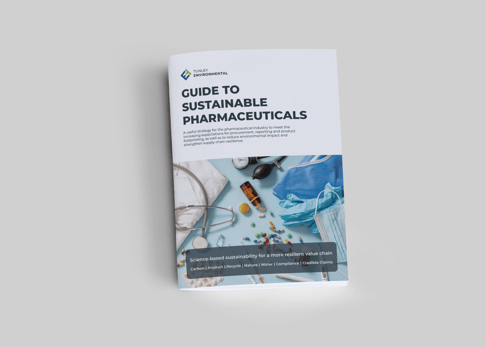
It will help you to:
- Identify material carbon, energy, water, waste, pollution, biodiversity and resource impacts
- Navigate compliance requirements and expectations
- Build an organisational carbon baseline and a credible, investable reduction plan
- Use pharmaceutical Life Cycle Assessment (LCA) and product carbon footprinting to understand impacts
- Improve Scope 3 data and supplier engagement
- Prioritise actions that support resilience, tender readiness, operational efficiency and defensible sustainability communication.
Internal Communication: Turning Assessment into Action
For PAS 2090 to be useful, its findings need to be understood inside the business. A life cycle assessment that remains as a technical report on a shared drive is unlikely to unlock its full value for the business. The value comes when results are translated into insight for the teams that influence product performance.
For instance, procurement teams may require an understanding of which suppliers possess critical data and where additional transparency is necessary. It may be necessary for manufacturing teams to comprehend the impact of process energy, yield, waste, or site-level improvements on the product. Together, packaging teams may need to evaluate material selections, recyclability, weight, and product protection. Commercial teams may require an understanding of which environmental messages can be communicated in a credible manner. Regulatory and quality teams may require assurance that proposed modifications do not jeopardise the integrity or compliance of the product.
External Communication: Making Claims With Confidence
PAS 2090 can also enhance the manner in which pharmaceutical companies communicate with their external audiences. The environmental impact of medicines is a topic of growing interest to healthcare providers, procurement authorities, investors, and a wider array of stakeholders. However, they also anticipate that the claims made are accurate, unambiguous and based on evidence.
This presents a challenge for pharmaceutical companies. On one hand, there is an increasing demand to demonstrate sustainability progress. On the other hand, regulatory and reputational risks may arise from vague or exaggerated assertions. There is a need to exercise caution when employing terms such as "sustainable," "low impact," or "greener," particularly when the supporting data is insufficient or the claim pertains to only a single aspect of the product life cycle.
Assessments conducted using the PAS 2090 life cycle assessment framework can help organisations communicate environmental claims with greater precision and transparency. Organisations can provide a more detailed explanation of the assessment, the boundaries that were employed, the life cycle stages that were considered, and the areas where enhancements have been identified, rather than relying on broad statements. This does not necessitate that all messages become exceedingly technical; however, it does suggest that external communication can be founded on empirical evidence.
There is potential for commercial value in this methodology. Pharmaceutical companies that are capable of furnishing comprehensive environmental data may be more effectively positioned to engage with healthcare consumers, respond to tenders, support ESG reporting, and showcase their progress to stakeholders. In this regard, PAS 2090 has the potential to transform environmental assessment into a competitive advantage, provided that the results are communicated in a responsible and transparent manner.
The Competitive Opportunity for Pharmaceutical Companies
Product safety, quality, efficacy and access will always remain central, but environmental performance is now part of the wider value conversation. Healthcare systems are under pressure to reduce their own environmental impacts and suppliers are increasingly expected to provide better data on the products they place into those systems.
The PAS 2090 life cycle assessment framework also helps pharmaceutical companies strengthen ESG reporting and respond to growing procurement expectations from healthcare systems. Businesses that understand the life cycle impact of their products are in a stronger position to answer stakeholder questions, identify improvement opportunities and demonstrate that sustainability decisions are based on science rather than assumption. This can support competitiveness not by encouraging larger claims, but by enabling better, more justifiable ones.
Companies that use PAS 2090 effectively can build stronger data systems, improve collaboration between teams and identify where environmental improvements may align with operational efficiency. This helps with improving competitiveness. For example, reducing waste, improving process efficiency, reviewing packaging or engaging suppliers may support both sustainability and commercial objectives, provided decisions are made carefully and with the full product life cycle in mind.
Where Pharmaceutical Companies Should Start
Step 1: Review existing environmental data
A logical starting point is to understand what product environmental data already exists and where the gaps are. This may include reviewing manufacturing data, supplier information, packaging specifications, distribution routes, product use assumptions, waste data and any previous LCA or carbon footprint work. The aim is to establish a clear baseline before making decisions about claims, improvements or wider rollout.
Step 2: Prioritise products or product categories
Once the baseline is clearer, organisations should decide which products or product categories to assess first. High volume products, strategically important medicines, products with visible packaging, products subject to procurement requirements, or products where environmental claims are already being discussed may all be suitable candidates for early assessment. Beginning with a defined scope can help teams build familiarity with PAS 2090 before applying it more widely.
Step 3: Involve the right teams early
PAS 2090 is not only an exercise purely for sustainability teams. It may require input from technical, operational, regulatory, quality, commercial and supply chain teams. Bringing these perspectives together early helps ensure the assessment is scientifically credible, practically useful and aligned with the realities of pharmaceutical product development, manufacturing and communication.
Turning PAS 2090 Into Practical Action in Pharmaceuticals
PAS 2090 may feel like another compliance task for pharmaceutical companies already managing complex regulatory and operational demands. That response is understandable, particularly in a sector where new requirements often mean more data, more process and more internal coordination.
However, PAS 2090 is also an opportunity to better understand pharmaceutical products. By encouraging companies to assess environmental impact across the full life cycle, the framework can support better internal decisions, more credible external communication and stronger evidence behind sustainability claims.
The companies that gain the most value will be those that use PAS 2090 as more than a reporting requirement. When findings are communicated properly within the business and translated carefully for external audiences, the framework can help pharmaceutical companies demonstrate leadership, improve market positioning and respond more confidently to growing expectations around product-level environmental impact.
How Tunley Can Help With The PAS 2090 Life Cycle Assessment Framework
By implementing the PAS 2090 life cycle assessment framework, pharmaceutical companies can improve environmental transparency and make more science-based sustainability decisions across the product life cycle.
Tunley Environmental supports pharmaceutical companies with science-based sustainability solutions including PAS 2090 support and specialist Life Cycle Assessments. To understand how PAS 2090 could apply to your products, visit our PAS 2090 service page or book a meeting with one of our scientists.