


A completed sustainability assessment should be the start of organisational sustainability progress rather than the end of a project. Think of it this way, leaving it unused is like buying a detailed map and never using it to choose your route. The report should be the start of measurable sustainability progress, not the end of the project. Whether the completed assessment covers operational carbon, a product Life Cycle Assessment (LCA), nature, water or another environmental priority, its value depends on what happens after the final report is delivered.
The report may contain a solid baseline, environmental hotspots, data limitations and practical recommendations. However, those findings will not reduce impacts or strengthen the business unless they are connected to strategy, responsibilities and ongoing measurement.
For organisations considering their sustainability project next steps, the priority should therefore be to convert technical findings into actions that different parts of the business can use.
| Quick navigation points throughout | |
What Does It Mean to Get Value from a Sustainability Report?
A sustainability report creates value when it changes what the organisation does. That may mean using the results to reduce energy consumption, redesign a product, improve supplier data, support a tender response or substantiate an environmental claim. In other cases, the immediate value may be a clearer understanding of risk, uncertainty or where further investigation is needed.
This is an important distinction. A report can be technically sound without yet being operationally useful. The organisation still needs to interpret the findings, decide which initiatives are most significant, and embed them into existing processes.
The most useful starting question is not simply, “What does the report say?” It is, “What should this evidence now influence?”
See how Inspired Entertainment's Business Carbon Assessment helped inform future carbon reduction priorities and product-related assessment work.
First, Prioritise Acting on the Findings
Environmental assessments often contain more potential actions than an organisation can implement at once. Prioritisation is therefore essential.
Begin by separating the findings into five categories:
-
Significant environmental hotspots
-
Gaps or weaknesses in the underlying data
-
Operational improvement opportunities
-
Risks requiring management attention
-
Evidence that could support commercial or communication needs
Each category may lead to a different response. An emissions hotspot may require engineering or procurement input, while a supplier data gap may require a structured engagement plan. Evidence of comparatively lower product impacts may be commercially valuable, but only if the comparison and supporting claim are properly framed.
Priorities should be assessed against environmental impact significance, feasibility, cost, regulatory or customer expectations and their relevance to wider business goals. This creates a stronger reason to act than selecting the easiest recommendations first.
How Should Different Types of Assessment Be Used?
The best route forward depends on what was assessed and why the project was commissioned.
An operational carbon assessment can inform emissions-reduction planning, energy investment, target-setting and engagement with suppliers responsible for material Scope 3 emissions. The GHG Protocol’s Scope 3 Standard identifies business goals including understanding value-chain risks and opportunities, tracking performance and engaging value-chain partners.
An LCA can inform businesses about materials, manufacturing, packaging, transport, product use and end-of-life treatment. Rather than treating the overall result as a single score, product and design teams should examine where impacts arise and which changes could produce tangible improvements. ISO 14040 includes interpretation as a formal LCA phase and requires the intended application to be considered when defining the study’s goal and scope.
A nature assessment can help an organisation identify dependencies, impacts, risks and opportunities associated with sites, operations and value chains. These findings can inform site management, risk registers, capital allocation and supplier discussions. The Taskforce on Nature-related Financial Disclosures similarly positions nature-related information as an input into governance, strategy, risk management and decision-making.
The report type may differ, but the principle is always to transform evidence from the sustainability assessment into recommendations relevant to those who can do something about it.
Turn Recommendations into an Action Register
A recommendation without ownership can easily stay untouched. Every priority should therefore be transferred into a simple action register.
For each action, record:
-
The finding or evidence behind it
-
The proposed response
-
The responsible owner
-
The teams that need to contribute
-
The resources or budget required
-
A target date
-
The indicator/metric used to measure progress
-
Any dependencies or uncertainties
-
The date on which the action will be reviewed
This process helps distinguish recommendations that can be implemented quickly from those requiring further analysis, investment or supplier involvement. It also gives senior leaders a clearer view of where resources are needed.
Ownership should lie within the department able to deliver the change. Sustainability teams can coordinate and provide technical guidance, but initiatives concerning machinery, materials, contracts or product specifications may belong with operations, procurement or product development.
Embed the Evidence into Existing Business Processes
Sustainability work is more likely to be fully implemented when it becomes part of processes that already influence business performance.
Relevant findings could be incorporated into:
-
Capital expenditure proposals
-
Product development gates
-
Enterprise risk registers
-
Tender libraries and customer questionnaires
-
Management dashboards
-
Marketing approval procedures
-
Annual planning and performance reviews
For example, an LCA hotspot associated with a particular material could become a criterion in future product briefs and supplier discussions. Operational carbon data could be considered alongside cost and payback when equipment is replaced. A nature-related risk could be added to the organisation’s existing risk-management process rather than monitored separately. This integration turns sustainability from an isolated workstream into a factor within routine business strategy.
Strengthen Supply Chain Sustainability
Many assessments reveal that the organisation cannot make progress alone. Missing supplier information, inconsistent calculation methods and limited visibility beyond direct operations are common barriers.
A focused supply chain sustainability strategy should begin with materiality. Organisations can identify the suppliers, materials or activities that have the greatest influence on the result and concentrate engagement there.
Data requests should explain what is needed, why it is important, the preferred format and any methodological requirements. Suppliers may also need guidance or time to improve their own measurement. The aim is not simply to collect more data, but to obtain information that can improve decisions and future assessments.
Where suppliers face similar carbon, product or nature-related challenges, collaboration may produce more value than a one-way questionnaire.
Keep the Report Alive Through Better Data Management
Environmental performance changes as operations, suppliers, products and methodologies evolve. A report based on a defined reporting period should therefore be treated as a baseline rather than a permanent description of performance.
Effective sustainability data management makes it possible to update key information, monitor actions and identify whether changes are producing the intended result. It also reduces the need to rebuild datasets from disconnected spreadsheets and emails each year.
Organisations should establish a review cycle proportionate to the subject. Some operational indicators may require monthly monitoring, while a full reassessment may be appropriate annually or following a significant change to the business, product or value chain. This creates continuity throughout the sustainability journey and makes future reports more useful.
Use the Evidence Commercially, but Carefully
Assessment results may support procurement submissions, customer questions, sales materials, websites or communications. This can increase the commercial value of work that has already been completed.
However, the language used must remain within the scope and limitations of the evidence. A study of one product, site or reporting period does not automatically support a broad claim about the whole organisation.
The CMA’s Green Claims Code guidance states that environmental claims should be clear, accurate and substantiated with robust, credible and current evidence. It also warns businesses to consider the full life cycle where this is relevant to the claim.
A useful report can strengthen sustainability communications, but it should not be stretched beyond what the methodology and findings can support.
Can Sustainability Progress Extend Beyond Your Organisation?
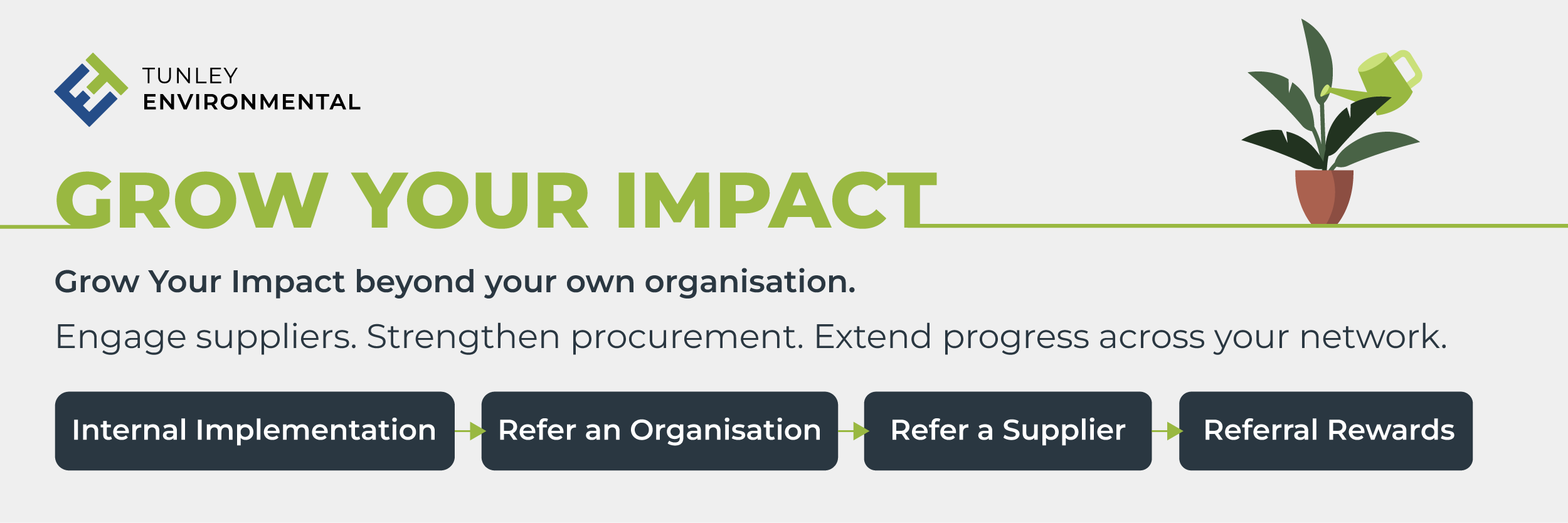
The next opportunity may belong to a supplier, procurement contact, customer, partner or group company facing a similar environmental challenge. Sharing knowledge and encouraging further assessment can improve evidence and capability across the wider network.
Tunley Environmental’s Grow Your Impact Progress Pathway and Rewards Scheme helps organisations identify useful next steps after completing a project. It also enables Tunley clients to introduce another organisation that could benefit from scientific sustainability support, extending progress across their network while receiving recognition for a successful referral. The objective is to identify where follow-on support, better data or collaboration can increase the value of work already completed.
The Bottom Line
A sustainability report should provide more than a record of what was measured. Its greatest value is found in the strategy it informs, the initiatives it enables and the evidence it creates for future measurement.
Organisations can promote sustainability progress by prioritising material findings, assigning clear ownership, integrating actions into existing processes and maintaining the underlying data. They can create further value by applying that evidence to procurement, products, tenders, communications and supplier engagement.
Tunley Environmental supports organisations in turning science-based assessments into next steps across their operations, products and value chains.