

Supply chains connect organisations to a complex network of suppliers, materials, transport routes, infrastructure and geographic locations. Climate change can introduce disruption at almost any point in that network, from flooding affecting a supplier site to drought reducing the availability of key raw materials or extreme heat placing pressure on transport and logistics.
Understanding how to manage supply chain climate risk and resilience therefore requires more than responding to individual events as they occur. Organisations need visibility over where climate-related vulnerabilities exist, an understanding of how those risks could evolve, and a plan for maintaining operations when disruption happens.
Building this understanding can help businesses move from reactive supply chain management to a more prepared approach.
|
Quick navigation points throughout the blog
|
|
| 1. What is supply chain climate risk? | 2. Why supply chain visibility matters |
What Is Supply Chain Climate Risk?
Supply chain climate risk describes the potential for climate change to disrupt the suppliers, resources, infrastructure and logistics that an organisation depends on.
These risks can take several forms:
- Physical risks: Flooding, storms, wildfires, drought and extreme temperatures can affect production facilities, transport infrastructure and the availability of natural resources.
- Transition risks: Changes in regulation, technology, customer expectations and the cost or availability of carbon-intensive materials can influence suppliers and procurement strategy.
- Supply chain dependencies: A business may have relatively limited climate exposure at its own sites while relying on suppliers, transport routes or materials located in areas facing much greater climate vulnerability.
This interconnected nature of modern supply chains means climate risk cannot be fully understood by looking at an organisation's direct operations alone. Transparency, proactive risk management, alternative supply arrangements and closer supplier relationships are important enablers of wider supply chain resilience.
Why Supply Chain Visibility Matters
One of the first challenges when assessing supply chain climate risk is understanding where the most significant dependencies are found. For organisations with complex or international supply chains, direct suppliers may represent only part of the picture. A critical material could originate several tiers further upstream, while multiple direct suppliers might ultimately rely on the same manufacturing location, transport hub or geographic region. This can create hidden concentration risks.
Greater supply chain visibility allows organisations to map important suppliers, materials and locations before considering their exposure to climate hazards. It also provides the foundation for more effective engagement with suppliers and helps businesses identify areas where further data may be required.
The assessment of supply chain risk is increasingly expanding outside the boundaries of historical operational data. Stakeholder engagement, supply chain due diligence, and risks that extend beyond an organisation's direct activities are also incorporated into broader sustainability risk methodologies.
Assessing Climate Exposure and Vulnerability
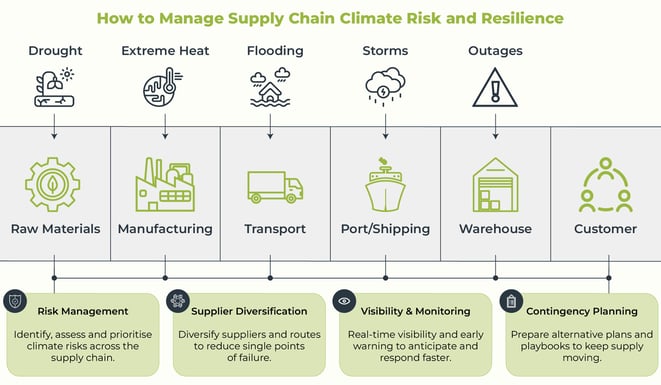 Once critical parts of the supply chain have been identified, organisations can begin assessing their exposure to relevant climate hazards.
The first question is whether important suppliers, facilities, materials or logistics routes are exposed to hazards such as flooding, drought, extreme heat, storms, wildfire or sea-level rise. Exposure alone, however, does not determine the level of risk.
Vulnerability is also a factor. For instance, two suppliers may be located in regions with comparable drought exposure, but the consequences could differ significantly if one relies heavily on water-intensive production while the other does not. Similarly, a supplier with strong flood defences, contingency procedures and alternative transport routes may be less vulnerable to the same hazard than another business.
A structured climate risk assessment therefore considers both the climate hazard and the sensitivity of the organisation or supplier exposed to that hazard. The methodology should combine an assessment of site and operational vulnerability with climate hazard identification, before risks are scored according to their likelihood and potential impact.
Look Beyond Current Climate Conditions
Historical disruption can provide useful information, but it cannot provide a complete view of future climate risk. Climate conditions are changing, which means organisations need to consider how hazards may develop across different future timeframes. A supplier location that currently has manageable heat exposure, for example, could face greater operational challenges as temperatures rise.
Scenario analysis can help organisations investigate how exposure changes under different climate futures rather than assuming that current conditions will remain constant. This supports more informed decisions about supplier selection, procurement strategy, infrastructure investment and long-term business continuity.
Tunley's Climate Risk & Resilience Strategy uses multiple emissions pathways and time horizons to assess how identified risks may evolve, helping organisations test potential adaptation decisions against different future conditions.
Prioritise the Risks That Have the Most Impact
Not every climate risk requires the same level of response. Effective supply chain climate risk management depends on distinguishing between potential hazards and the risks that could have a material effect on the organisation. This means considering factors such as the likelihood of disruption, its possible operational or financial impact, the criticality of the affected supplier and the availability of alternatives.
A component sourced from a climate-exposed region may represent a particularly significant risk where there is only one approved supplier and replacing that supplier would take several months. Conversely, exposure may be easier to manage where alternative suppliers, routes or materials are already available.
Prioritisation allows organisations to direct resources towards the areas where resilience measures can deliver the greatest value.
Build Alternatives Before They Are Needed
Ultimately, practical resilience planning should result from an understanding of the location of climate risks. Potential actions may vary depending on the organisation and the identified risks, such as:
-
Diversifying critical suppliers to reduce reliance on a single source.
-
Establishing alternative transport routes or logistics arrangements.
-
Reviewing inventory strategies for essential materials or components.
-
Identifying suitable substitute materials or products where possible.
-
Developing contingency plans for suppliers or locations facing higher climate exposure.
Supplier diversification and flexible sourcing arrangements are approaches that can help businesses adapt when supply or demand changes unexpectedly.
The purpose is not necessarily to remove every source of climate risk. In a complex global supply chain, that may be unrealistic. Instead, organisations can reduce dependency on single points of failure and establish options that allow them to respond more effectively when disruption occurs.
Resilience measures should also be proportionate. Building unnecessary redundancy across a supply chain can increase costs without providing proportionate benefits. This highlights the importance of assessing and prioritising risks to determine where adaptation investment is most needed.
Work With Suppliers to Strengthen Resilience
Supply chain resilience cannot be developed effectively in isolation. Suppliers often hold important information about their own operational dependencies, vulnerabilities and existing climate adaptation measures.
Regular engagement can help organisations understand whether critical suppliers have assessed their climate exposure, what continuity arrangements are already in place and where additional resilience measures may be beneficial.
This transitions supplier relationships from transactional procurement to collaborative risk management. Strategic partnerships with key suppliers, which are facilitated by communication and alignment regarding risk mitigation and continuity, are a critical element of resilient supply chains.
Additionally, it is appropriate to conduct periodic assessments of climate risk rather than approaching it as a singular project. Supplier networks undergo modifications, new dependencies arise, and climate hazards persist in their continuous development. Continual monitoring of material risks and the updating of resilience measures are essential for maintaining the relevance of plans.
How to Manage Supply Chain Climate Risk and Resilience in you Organisation
Understanding how to manage supply chain climate risk and resilience begins with developing a mapped structure of the organisation's supply chain, identifying critical dependencies and assessing their exposure and vulnerability to climate-related hazards. Those risks can then be prioritised according to their potential impact before appropriate resilience measures are developed. Rather than waiting for disruption to reveal weaknesses in a supply chain, organisations can identify vulnerabilities earlier, engage suppliers and establish proportionate contingency measures.
Tunley Environmental's Climate Risk & Resilience Assessment supports organisations in identifying and prioritising physical and transition climate risks, as well as associated reputational risks, across their operations, assets and value chains. Our science-based approach combines vulnerability assessment, climate hazard analysis and advanced scenario modelling before translating the findings into a practical Climate Resilience Plan.
Organisations can build supply chains that are more resilient to a changing climate by recognising the current state of exposure and its potential future modifications.