


This blog was updated on 09/06/2026
The construction industry remains one of the most resource-intensive industries in the world. Data from the United Nations Environment Programme (UNEP) shows that buildings and construction are responsible for about 37% of the world's carbon dioxide emissions related to energy and process. At the same time, investors, regulators, and tenants are all asking for clear improvements in how well the environment works, how open it is, and how well it can handle climate change. Against this backdrop, the BREEAM assessment process has become one of the most well-known and respected ways to demonstrate sustainably constructed buildings and infrastructure. BREEAM, which was created by the Building Research Establishment (BRE), has been the sustainable building standard for more than 30 years.
| Quick navigation points throughout the blog | |
| 1. What is BREEAM? | 2. Overview of the BREEAM Assessment Process |
| 3. The Business Case for BREEAM Certification | 4. Integration with Whole Lifecycle Carbon Assessment |
What is BREEAM?
BREEAM stands for the Building Research Establishment Environmental Assessment Method. It was first launched in 1990 by the Building Research Establishment (BRE) in the United Kingdom. Today, it operates globally and has certified hundreds of thousands of buildings, with millions more registered for assessment.
BREEAM is a sustainable building certification system that:
-
Assesses environmental performance across a range of categories
-
Awards credits based on performance benchmarks
-
Provides an overall rating (Pass, Good, Very Good, Excellent or Outstanding)
- Encourages whole-life thinking in sustainable construction
The framework has expanded beyond new construction to cover refurbishment, in-use buildings and infrastructure. The BRE Building Research Establishment continues to refine methodologies to reflect evolving sustainability standards and climate science. Understanding the BREEAM assessment process is what enables organisations to translate ambition into measurable outcomes.
Overview of the BREEAM Assessment Process
The BREEAM assessment process is based on a structured and evidence-based method. While specific schemes differ slightly (e.g. BREEAM New Construction, BREEAM Infrastructure), the overarching steps remain consistent.
The process typically includes:
-
Project registration
-
Appointment of a licensed BREEAM Assessor
-
Pre-assessment and target setting
-
Design stage assessment
-
Construction stage assessment
- Final certification
Each step is supported by documentation, evidence submission and independent quality assurance conducted by BRE.
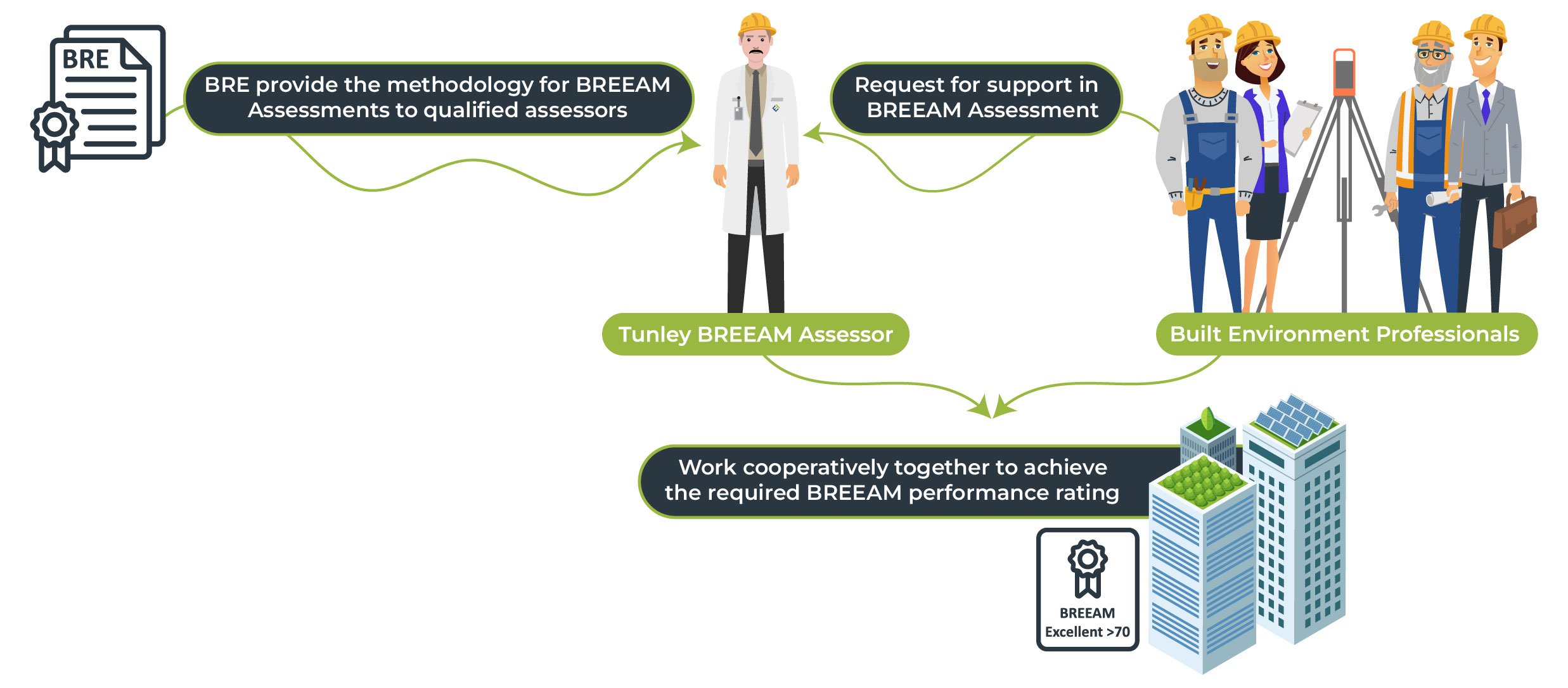
Step 1: Project Registration
The BREEAM assessment process begins with formal registration of the project with BRE. At this stage:
-
The organisation must find a licensed BREEAM assessor to work with
- The BREEAM assessor registers the project with the BRE system
Selecting the correct scheme is crucial. Options may include:
-
BREEAM New Construction
-
BREEAM Refurbishment and Fit-Out
-
BREEAM In-Use
- BREEAM Infrastructure
The choice depends on asset type, lifecycle stage and project objectives within sustainable construction.
Step 2: Pre-Assessment and Strategy Development
Once registered, the BREEAM assessment process moves into pre-assessment. This stage establishes:
-
Target rating (e.g. Excellent or Outstanding)
-
Feasibility of achieving credits
-
Cost implications
- Risk areas
The BREEAM Assessor conducts a gap analysis against criteria such as:
-
Energy performance
-
Water efficiency
-
Materials selection
-
Waste management
-
Ecology and biodiversity
-
Pollution control
- Health and wellbeing
Early integration is critical. Sustainable building performance is most cost-effective when embedded during concept design rather than retrofitted later.
Step 3: Design Stage Assessment
A critical milestone in the BREEAM assessment process is the Design Stage (DS) assessment. At this point:
-
Design documentation is reviewed
-
Evidence is compiled and submitted
- Credits are provisionally awarded
The assessor submits the Design Stage report to BRE for quality assurance. If compliant, a Design Stage certificate is issued. This early certification is valuable because it:
-
Demonstrates commitment during construction
-
Supports planning conditions
- Provides reassurance to investors
However, it remains provisional until the post-construction stage confirms delivery.
Step 4: Construction Stage Assessment
The Post Construction Stage (PCS) forms the final verification element of the BREEAM assessment process.
During this stage:
-
As-built evidence is collected
-
Site inspections may occur
-
Commissioning documentation is reviewed
- Performance data is validated
Any design-stage assumptions must be proven in practice. For example:
-
Energy systems must match specifications
-
Materials must reflect approved selections
- Waste management targets must be evidenced
Once submitted, BRE conducts quality assurance before issuing the final BREEAM certification.
BREEAM Scoring and Rating System
The BREEAM assessment process translates credits into percentage scores.
Ratings typically include:
-
Pass (≥30%)
-
Good (≥45%)
-
Very Good (≥55%)
-
Excellent (≥70%)
- Outstanding (≥85%)
Achieving Outstanding requires exceptional performance across categories, often incorporating advanced sustainable building strategies such as renewable energy integration, Whole Life Cycle Assessment (WLCA) modelling and biodiversity net gain.
The Business Case for BREEAM Certification
Beyond environmental benefits, BREEAM certification offers certain strategic advantages including:
-
Risk Mitigation: It reduces exposure to regulatory tightening around energy efficiency and carbon disclosure.
-
Market Differentiation: Certified sustainable building assets are often more attractive to occupiers and investors.
-
Asset Value Protection: As minimum energy standards increase, certified buildings are less likely to become stranded assets.
According to industry commentary from BRE and sector analysts, high-performing sustainable construction assets demonstrate improved long-term resilience in increasingly climate-conscious markets.
Integration with Whole Life Carbon Assessment (WLCA)
Part of BREEAM awards credits for a compliant WLCA completed during different project phases, recognising the importance of measuring and reducing embodied and operational carbon across the asset lifecycle. Within the BREEAM assessment process, undertaking a whole life carbon assessment at concept, technical design and post-construction stages can directly contribute to higher scores, particularly in Energy and Materials categories, while strengthening overall sustainable construction performance.
Learn more: Understanding the UK Net Zero Buildings Council
The Bottom Line
Expectations around sustainability in construction will continue to grow, and as such, independent verification frameworks will become more important to development strategy. The BREEAM assessment process provides a clear, organised, and internationally recognised way to show how well a building or other structure is doing in terms of the environment. It makes sure that sustainability is a part of design, construction, and operational performance from the time a project is registered until it is certified.