

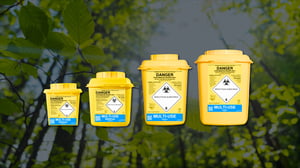
Conduct a Life Cycle Assessment (LCA) of Sharpak Zero Reusable Sharps Containers.

Sharpak Healthcare Case Study
Sharpak Healthcare develops clinical waste containers, including its Sharpak Zero range of reusable sharps bins.
Unlike traditional single-use sharps containers, which are typically incinerated after use, Sharpak Zero containers are designed to be collected, emptied, sanitised, repacked and returned to service. The reusable system offers an alternative to single-use disposal, with the assessment examining scenarios involving both 100 and 1,000 uses before the containers are reclaimed.
To better understand the environmental benefits of this approach, Sharpak Healthcare partnered with Tunley Environmental to conduct a Life Cycle Assessment (LCA) of its reusable sharps containers, comparing their carbon footprint with equivalent single-use alternatives.
The Challenge
Although Sharpak Healthcare recognised the potential carbon benefits of reusable sharps containers, demonstrating these benefits through reliable, independently reviewed evidence was essential.
Comparing reusable and single-use products requires consideration of emissions across their respective lifecycles, including the additional processes involved in collecting, sanitising and redistributing reusable containers.
Without specialist Life Cycle Assessment expertise available internally, Sharpak Healthcare needed a partner who could conduct a robust, standards-based assessment and provide credible evidence to support its environmental claims.
This was particularly important when speaking with customers and procurement teams where sustainability claims are increasingly under the microscope.
Our Approach
Tunley Environmental assessed the carbon footprint of the Sharpak Zero reusable sharps container range in accordance with ISO 14067 through a Life Cycle Assessment (LCA). The assessment compared the greenhouse gas emissions associated with reusable containers against equivalent single-use alternatives, accounting for the full product lifecycle, from raw material extraction through to end-of-life disposal.
By examining emissions across different reuse scenarios, Tunley’s Sustainability Scientist, Dr Annaelle Hip Kam, was able to identify the carbon savings associated with the reusable system and provide insight into the activities contributing to its overall footprint.
The project involved close collaboration with Sharpak Healthcare, including addressing data gaps, reviewing information and ensuring the assessment accurately represented the products and processes being evaluated.
The Impact
Beyond demonstrating the carbon benefits of reusable sharps containers, the assessment provided Sharpak Healthcare with a clearer understanding of where emissions occur throughout the product lifecycle. This insight has helped the business identify areas for improvement and make more informed decisions about its future sustainability priorities.
The findings also provide a credible, science-based foundation for communicating the environmental performance of Sharpak Zero to customers and procurement teams. Rather than relying on assumptions about the benefits of reuse, Sharpak Healthcare can now reference quantified evidence demonstrating the carbon savings achievable across different reuse scenarios.
The Results
The assessment identified substantial carbon reductions when comparing the Sharpak Zero 60 reusable container with equivalent single-use alternatives.
When comparing one reusable container used 100 times against 100 equivalent single-use containers, the assessment found:
-
The reusable container produced 17.8 kg CO2e across 100 uses
-
Using 100 equivalent single-use containers would produce 146 kg CO2e
-
The reusable system achieved an 87.8% reduction in carbon emissions compared with the single-use alternatives.
The assessment also considered a scenario involving 1,000 uses, identifying:
-
The reusable container produced 166 kg CO2e across 1,000 uses
-
Using 1,000 equivalent single-use containers would produce 1,458 kg CO2e
-
The reusable system achieved an 88.6% reduction in carbon emissions compared with the single-use alternatives.
Both scenarios demonstrated substantial carbon savings compared with equivalent single-use containers. While the 1,000-use scenario produced higher total emissions due to the greater number of uses, it achieved a slightly higher percentage reduction of 88.6%, compared with 87.8% across 100 uses.
The findings demonstrate how continued reuse can deliver additional carbon benefits, while highlighting the emissions associated with ongoing collection, sanitisation, repacking and redistribution. This provides Sharpak Healthcare with valuable insight to support continued environmental improvement.
Working with Tunley Environmental
“Working with the Tunley team has been collaborative from the off. They came back to us with questions, worked through gaps in the data with us directly and clearly wanted the number to be right as much as we did. You could tell there was a genuinely qualified team behind it.”
Kieron King
Standards and Sustainability Manager at Sharpak Healthcare